You can watch the video on Youtube here : https://youtu.be/jcWHuXAWao0

from WordPress https://reviewandbonuss.wordpress.com/2017/09/16/insta-ecom-express-review-insta-ecom-express-bonus/
You can watch the video on Youtube here : https://youtu.be/jcWHuXAWao0
Insta Ecom Express – what is it? Insta Ecom Express is a new wordpress plugin that allows you to build complete ecom affiliate websites in under 60 seconds. This WordPress Plugin will automatically :
Basically, this plugin will build a complete Ecom affiliate website in under 60 seconds. In addition, the software has built in integration for content spinners and social media. So when the you add a new product the plugin will automatically spin the content and submit it to social media sites!

The next blog post was initially seen on Insta Ecom Express Review : Bonus

You can watch the video on Youtube here : https://youtu.be/Yzn22NFVoKI

The following content was initially seen on SociBot Review : Bonus
SociBot is an all in one Facebook traffic and commission getting software that will help you to grow your business on autopilot, even whilst your asleep! The software allows you to build huge list of people who comment and engage with your Facebook posts, then allowing you to direct message these people in a bid to sell your products and services.
In addition to the main feature that SociBot allows you to build a list and capture the audience of people that engage with your posts, the software has a huge list of awesome feautres that will help you to build your online business.
Under one dashboard, the SociBot platform has a wealth of features, including the ability to automatically respond to messages your fan page receives and automatically respond to comments your fanpage recieves by direct messaging to the person via the FB inbox.
The SociBot software also has a unique features that enables you to import anyone who has historically messaged your page, into a ‘list’ which you can then mass message.
SociBot also has a button generator tool which will allow you to place a button onto your website, blog or landing page which, when clicked, will open the Facebook messenger window, allowing your customers, prospects or viewers to message you direct.


Better customer experiences will be a central topic at Oracle OpenWorld 2017, which takes place October 1 to 5 in San Francisco. Oracle experts, customers, and industry thought leaders will share how artificial intelligence (AI) technology is enhancing customer acquisition, retention, and loyalty by offering consumers the best possible interactions across all channels.
Oracle’s approach to AI, known as Adaptive Intelligence, combines several technologies, including data science, artificial intelligence, and machine learning. AI-powered systems can recognize images, understand language, learn from data, and emulate human intelligence. Oracle’s recently introduced suite of Adaptive Intelligent applications is focused first on applying customer insights derived from AI to the transformation of customer experience, and will soon span the enterprise to include applications for finance, human resources, and supply chain management.
“Companies are looking to AI to help them derive greater customer insight with every interaction a customer has with them. Adaptive Intelligence creates that insight and also delivers the right offer or content that will best meet that customer’s individual need in that moment,” says Des Cahill, Oracle’s head CX evangelist. And when customers continue to have positive experiences time and again, Cahill adds, their loyalty increases and helps cement the company’s competitive position.
Here are Cahill’s top picks for Oracle OpenWorld AI sessions that CX professionals shouldn’t miss.
Skyrocketing Customer Expectations
At the top of the list is a keynote called "Exceed Skyrocketing Customer Expectations with Oracle,” where Rondy Ng, senior vice president of applications development, and Laura Ipsen, general manager and senior vice president for Oracle Marketing Cloud, will discuss how emerging technologies are causing customer expectations to change—and how Oracle can help organizations exceed those expectations.
Connecting Every Customer Touchpoint
Because today’s customers expect positive experiences no matter which channel they choose to use, companies need to be able to track and evaluate each customer interaction. The following sessions will help attendees create a roadmap to customer experience success.
In “Connected Intelligence Transforms Your Business,” Jack Berkowitz, Oracle vice president of product management and data science for Adaptive Intelligent Apps, will describe how those applications solve specific business challenges, demo the apps, and talk about the roadmap to customer experience transformation. Another session, “Connected Intelligence for Better Service,” shows service leaders how AI apps for CX can provide a holistic view of customers’ interactions, quickly resolve open issues, and recommend the next-best actions.
Hyperpersonalizing Customer Connections
Because AI helps companies understand so much about their customers’ buying history and preferences, the new applications can help ecommerce leaders hyperpersonalize their outreach, tailoring it with a precision not previously possible.
In “Hyperpersonalizing Customer Interactions to Supercharge Sales and Close Deals,” Oracle executives will lead a discussion and demo showing how sales leaders can use the new AI apps to optimize lead scoring, plan next-best actions, and plan smart messages with the context of the account history to keep customer conversations on message.
In “Decision Science and Artificial Intelligence for Enhancing Commerce,” Tara Roberts, vice president of product management and UX for Oracle Adaptive Intelligent Apps, will explain how to refine, improve, and hyperpersonalize customer experiences for seamless cross-channel commerce.
Finally, a session called “Using the Power of Artificial Intelligence to Enhance Marketing” promises a powerful overview of how AI can help marketers achieve their goals by delivering the right content to the right person at the right time.
To take a look at all the Oracle OpenWorld programming, check out the session catalog.

If you’re looking for new ways to prospect new business for your product or service, a lead magnet could be a valuable investment. A lead magnet is essentially a gateway drug or a bribe to coax your target audience into your marketing or sales funnel. You ‘bribe’ a prospect with a specific piece of value in exchange for their contact information that you can then use to nurture a relationship that hopefully leads to a sale.
The value offer of lead magnets are often pieces of content like:
But they can also be:
I’m sure all of these types of lead magnets have been successful for many businesses at some point in time, but at Proposify, we’ve found that a lead magnet that’s built directly into our SaaS product is the most effective way to attract qualified users who then convert to paying customers.
A lead magnet that’s part of your product is different from the examples listed above because it’s usually specific to your product and service. Done right, this type of lead magnet should demonstrate the value and benefit you can provide to your prospect if they choose to pay for your product or service.
Using our experience at Proposify, along with other examples, I’ll outline six steps to building a successful lead magnet into your product.
At Proposify, we use business proposal templates as a lead magnet to drive free trials of our online proposal software.
Proposal templates are free, but they can only be used within our product, so the user has to sign up for a free 14-day trial of Proposify.
The templates then act both as a top of funnel acquisition tool, and they help new users onboard faster.
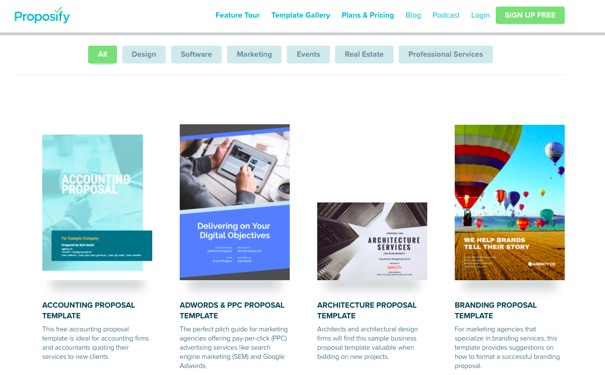
We offer a document (proposal template) that is specifically related to our product (online proposal software), and specific to an industry (accounting, marketing, architecture, etc). Combined with some SEO work, we end up ranking quite high on Google search results for keywords our target audience is searching for in their time of need.
Someone who is banging their head on their desk trying to write a marketing proposal for a new client is likely to search for “marketing proposal template,” and may find us via our paid or organic search results. This is a key aspect of an effective lead magnet: you need to be visible during your ideal prospect’s time of need and provide a specific piece of value to help them in that moment.
Another example of this is SEOptimer. They rank first for the keyword “free SEO audit” with their free SEO Audit Tool. Someone who is not an SEO expert may struggle with where to start when tackling their site’s SEO performance. Many websites make it easy for those people to get a high-level view of their site’s performance with a free SEO/website audit/grader of some sort.
Technically, it’s just a fancy website scraper and checklist, but for someone who doesn’t know much about SEO, or who’s looking for a quick, high-level view, this tool can be extremely valuable. This lead magnet is part of SEOptimer’s product that they give away solely for the purpose of generating leads.
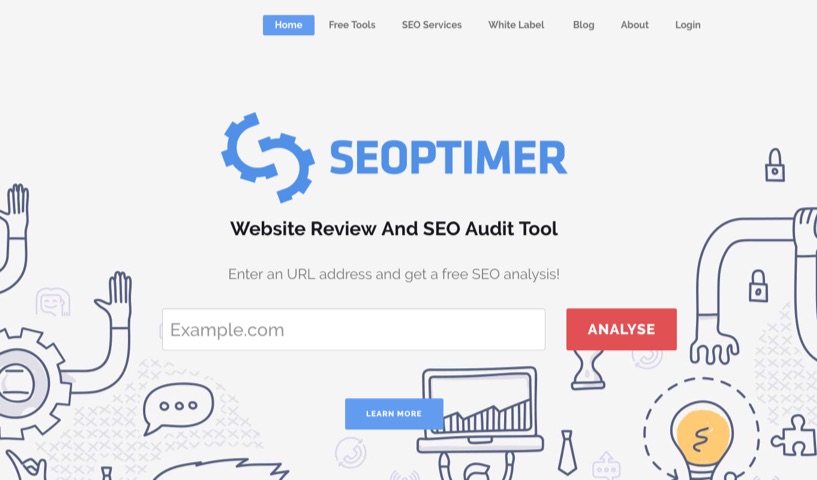
This tactic likely drives a lot of top of funnel traffic for SEOptimer, but could stumble when trying to contact leads, since they don’t ask for your email. They could do retargeting, or domain matching to emails, but I can’t confirm. The sixth steps gets more into developing the relationship, an area where SEOptimer could improve.
It sounds like a no brainer, but your lead magnet needs to be valuable to your lead. Content marketing is exploding, and competition for your audience’s attention online has likely never been tougher than it is today.
The only way to break through all of the noise is to create something of value that attracts your audience, holds their interest, and is valuable enough that ideally, they share it with their network. We like to think that if someone would be willing to pay for your lead magnet, but you’re giving it away at no monetary cost, then it offers value.
Our templates save time, money, and sanity. Coming up with designs and copy can be a huge timesuck when you’re trying to get a proposal out the door to a potential client quickly, so our free templates are a high-value offer.

HubSpot is another great example of a company that gives a lot of value away for free; in fact, they give away an entire CRM for free. HubSpot has tons of content on lead magnets, and they certainly practice what they preach. As part of HubSpot’s marketing, they’re challenged with selling the concept of inbound marketing as well as their complementary inbound marketing products. What better way to get people into inbound marketing and the HubSpot ecosystem than to give away parts of it for free?
You need to remove any barriers that might make it difficult for your target audience to recognize the value of your lead magnet. A common mistake is adding too many fields in your lead generation form, which results in a lower conversion rate. You need to find a way to pull as much data as you can from your lead, without turning them off from submitting.
Building a lead magnet into your product should also have the added benefit of making it easier for a user to get into your product. Our proposal templates help attract new users, but they also help speed up our customer onboarding process by making it simpler for users to send proposals faster.
The aforementioned SEOptimer makes it extremely easy to get value from their free Website Review SEO Audit Tool. All you have to do is enter your domain and go; no long forms to fill out or extra information to provide. HubSpot’s free CRM mentions right in the support documentation that they are, “Confident that you can get set up in less than 10 minutes”, making it an uncomplicated decision for the user to get started right away.
After you’ve made it as easy as possible for your lead to get to the meat of your lead magnet, you need to provide some instant gratification. If the user doesn’t find value quickly, they’ll be less likely to continue to engage with your lead magnet, and certainly less likely to pay attention to any future lead nurturing or conversion tactics you may deploy.
Part of the reason we have proposal templates is to shorten the process between when a user starts a free trial, and when they send out their first proposal. The templates reduce the arduous task of spending hours on a design or layout and instead gets the user closer to the gratification of sending out a proposal and winning new business, an area of great satisfaction for our customers, and a leading metric of success for the adoption rate of Proposify.
With SEOptimer’s audit tool, seconds after you enter your domain they deliver a free, high-level website audit with an easy-to-understand grading system. They make it easy to learn how they break down their grading system, in addition to identifying the most necessary improvements for your domain.

Providing a high-quality, and visually appealing report like this in a matter of seconds is a great example of providing instant gratification for a lead magnet. It is something you can easily understand, get value from, and take action with right away.
While this is a list of six things you should do when building a lead magnet into your product (and you should do them all!), this one is the most important step.
Building a lead magnet into your product should communicate your true value proposition. A lead magnet that’s part of your product helps the user understand what you can do for them, and demonstrates the potential value before they pay for it. This is the precise reason that free product trials exist.
A lead magnet that clearly demonstrates your value proposition is the holy grail, whether it’s built into your product or not. Someone who is experiencing a problem that you can solve and finds your lead magnet is a very qualified lead and will be much more likely to investigate your product or service further.
We’ve seen this with our proposal templates. Once a user signs up for Proposify’s free trial and uses a template to send a proposal, they also experience our other valuable features such as proposal metrics, digital signatures, variables, and content library.
Another great example of this is ChartMogul, a SaaS subscription reporting, analytics, and metrics tool. Although they don’t rank organically on the first page of Google for “LTV calculator,” they have a great example of a free tool that demonstrates the value of their product.

Having an LTV (lifetime value) calculator is great for a one-off calculation, and much easier than manually doing it. But, it’s very likely that if you’re someone looking to find out what your LTV is once, you’re going to want to track that on a more frequent basis, with, say, a dashboard. That’s exactly what ChartMogul does, and they have a handy call-to-action right below the calculator to let you know.

Similar to how SEOptimer’s audit tool identifies areas of improvement in your website, the company WordStream offers a tool that grades your Google AdWords account.
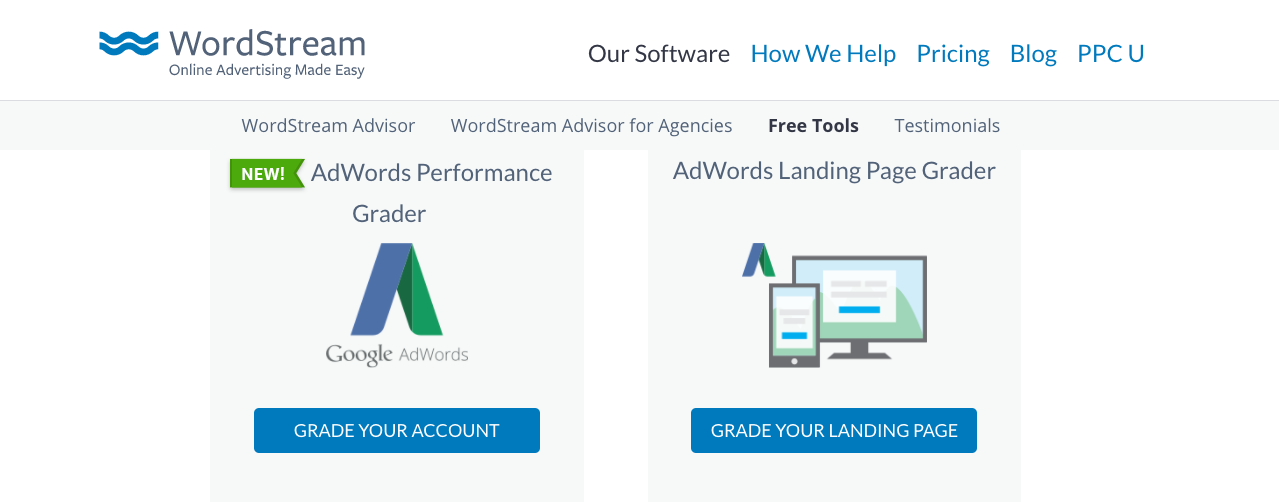
After using their product to grade your AdWords account, they are betting on the fact that they will find areas of improvement, and that their PPC software will be more attractive. The tool could also help WordStream segment their audience and identify accounts that spend a lot on AdWords, and could easily find a positive ROI from their software.
Finally, your lead magnet may be valuable to your user, but it’s not valuable to your business unless you nurture the relationship, bringing the prospect closer to the point of purchase.
Examples of nurturing the relationship are varied depending on where the prospect is in your marketing or sales funnel. Typically in B2B, it might include an automated email drip campaign; qualifying information such as industry, company size, or job title; following the brand’s social profile; or booking a call with a salesperson.
Users of our templates must sign up for a free trial with their name and email, and this enters them into our onboarding drip sequence. Once users enter this sequence, they can be further qualified based on their activity, like number of sessions, proposals sent, and users added.
If you’ve ever downloaded a HubSpot lead magnet, then I’m sure you’ve experienced being ‘nurtured’. I won’t go into best practices for nurturing sales leads, but HubSpot has tested more than a few different tactics. I found this one interesting: a colleague and I entered HubSpot’s CRM at different times, but by linking our company information, this “Product Specialist” was alerted and reached out to me:

SEOptimer includes two calls-to-action in their email; one for connecting you with SEO services, and another for white-labeling their lead magnet as your own. Essentially this means that their main lead magnet is not just built into their product, it IS their product, making it about the most meta example of building a lead magnet into your product that you can find!
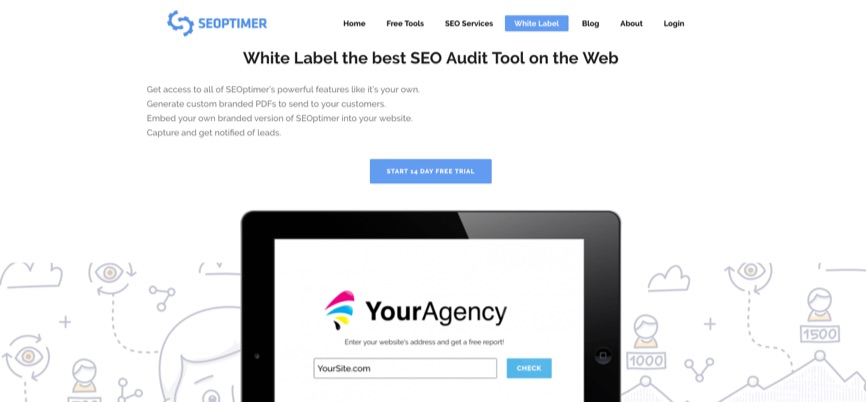
However, SEOptimer could improve their ability to develop the relationship after you use their lead magnet. I have not once been contacted or retargeted about white-labeling their SEO audit tool. That being said, I don’t work at an agency pitching SEO services, so perhaps they’re doing a good job at weeding out unqualified leads.
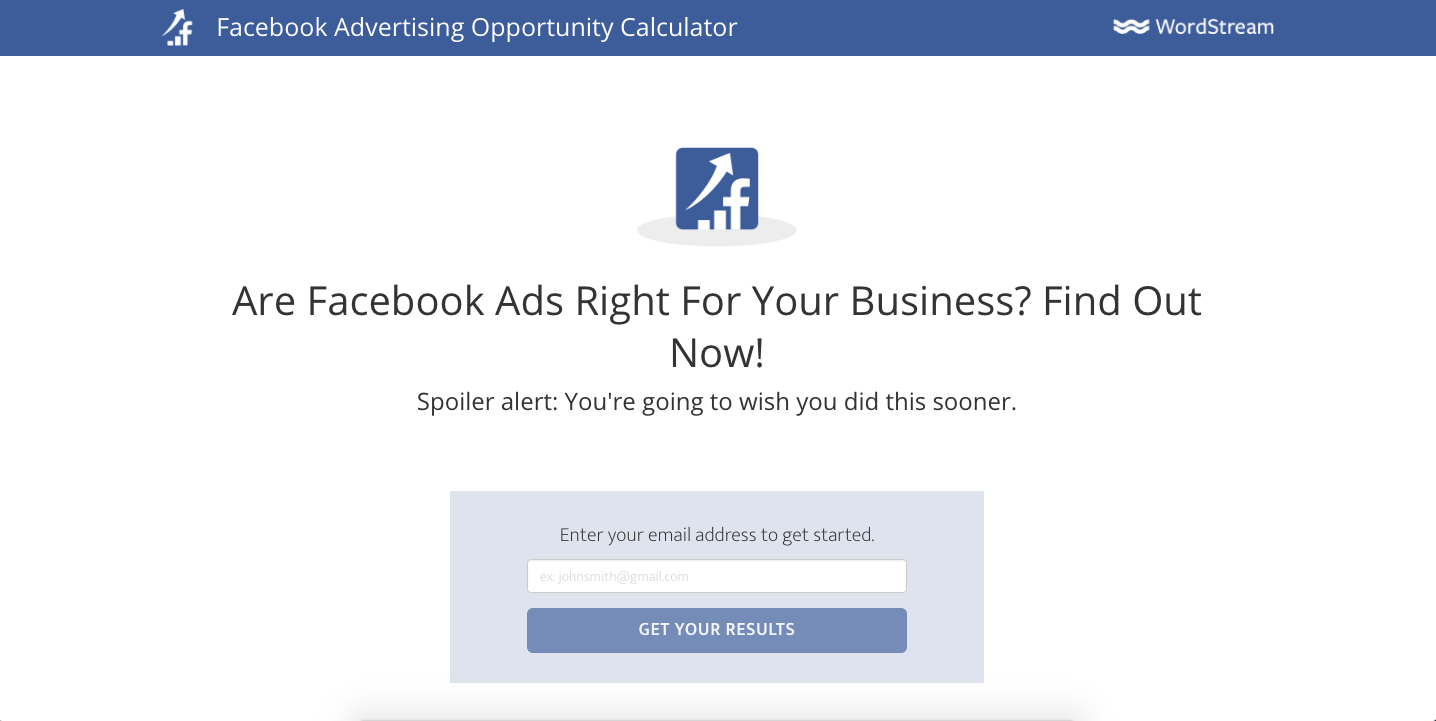
WordStream does a better job of moving the user to the next stage of their funnel, as they require you to enter your email before actually using their free tools.
After you create your lead magnet, crossing your fingers and hoping for the best probably isn’t the best course of action. Make sure you’re tracking each stage of your prospect’s lead magnet journey with a tool like Kissmetrics.
How much traffic is the lead magnet driving? What’s the conversion rate for a new user who visits your landing page and ends up using your lead magnet? What’s the conversion rate of people who use your lead magnet and then become a paying customer?
Building a lead magnet into our product has delivered amazing results. More than half of our new website traffic is via a landing page, and those that view a proposal template are 2.5 times more likely to sign up for a trial than those that don’t.
If you’re thinking about building a lead magnet into your product or perhaps leveraging something you already have, I hope the six steps above help to guide you to success.
About the Author: As Chief Marketing Officer at Proposify, Patrick Edmonds gets his kicks from measurable results. He loves to get his hands dirty digging deep into data (especially on lead magnet business proposal templates) to discover new ways to convert more customers to the Proposify way of life.


You can watch the video on Youtube here : https://youtu.be/f0TSMXfXWQ0

Tabfu Pro is a new software that allows Facebook based businesses and marketers to interact with their audience within Facebook, by using the power of Facebook tabs.
Tabfu Pro software has been created with over 2 years of research and development and all the content and templates present in the software has been crafted by online marketing experts by researching the most converting designs and content.
With the help of this software you can create : lead capture pages, sales pages, click through pages, launch pages, about us pages, software pages, webinar pages, contact pages and app feature pages. With Tabfu Pro, you’ll be able to create stunning Facebook Landing pages with a few clicks or your mouse. Your Facebook page will stand out from the crowd and you’ll boost your conversions, get more leads, and ultimately save time and make more money!

With the Advanced Analytics and CRM integration so you can track your campaigns and optimize your pages for maximum profits…. ENJOY a large and customizable stock library of eye-popping images, icons and animations to use in your posts.
Tabfu Pro also drives fress Facebook traffic to your campaigns with a brand new technology called ‘Motion Posts’ – generating leads and sales in no time. …and that’s just the tip of this money making, lead generating viral iceberg! You’ll be amazed at how easy it is for you to create professional facebook tabs like a pro – without touching a single line of code!
The following blog post was first seen on Tabfu Pro Review : Bonus

Analytics is a blessing to marketers because of the wealth of data it provides.
It’s “the most measurable medium.”
Online marketers can analyze and dissect innumerable elements to gain a deeper understanding of the habits and preferences of their customers.
As a result, they can effectively put themselves in their customers’ shoes and optimize the entire experience. This allows them to fine-tune even the most minute aspects of their campaign, thereby improving customer satisfaction and increasing sales.
But this also creates of a quandary. With such an abundance of data points available, it can be a little perplexing deciding which behavioral metrics to focus on.
So, what do you do?
In this article, I attempt to answer the question by suggesting seven of the most important behavioral metrics that drive business.
Sometimes, the sheer volume of behavioral metrics can feel paralyzing. Just look at this list of examples provided by Scott Roever of CompUSA:
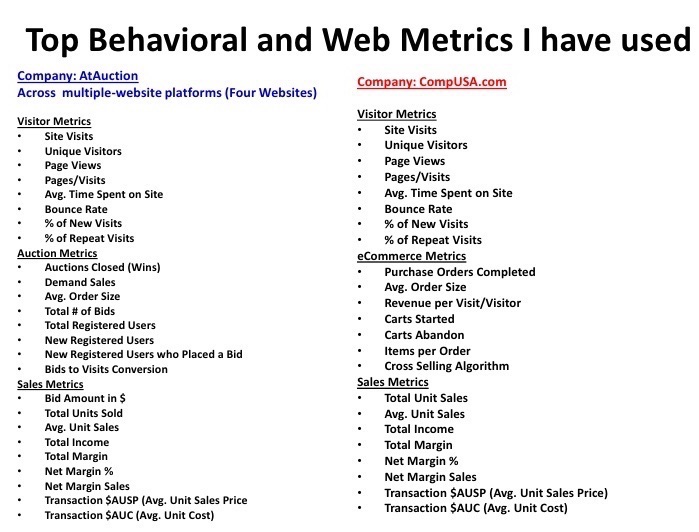
And here’s some more:

See what I mean?
Things can get murky in a hurry. So which behavioral metrics most demand your attention?
Obviously, it can definitely vary from company to company, but it all boils down to answering a single crucial question — what behavioral metrics impact your key business drivers?
For most businesses, there are three key business drivers in play:
Here’s how to go about mapping behavioral metrics into these key business drivers.
There are two behavioral metrics that heavily impact revenue.
Conversion rate and churn.
Conversion rate influences your ROI and overall bottom line.
It’s also what allows you to benchmark your website month-to-month and year-to-year to track long-term progress.
Therefore, it’s arguably the most important metric to examine pound-for-pound.
One of the simplest tools for determining how your conversion rate directly impacts your revenue is this one from Foremost Media:
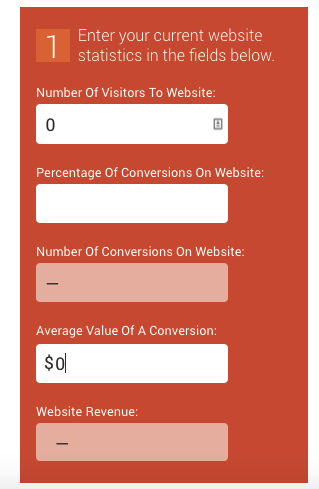
It’s pretty straightforward.
Enter the average number of visitors to your website each month, the percentage of visitors that convert and the average value of a conversion.
Here’s an example:
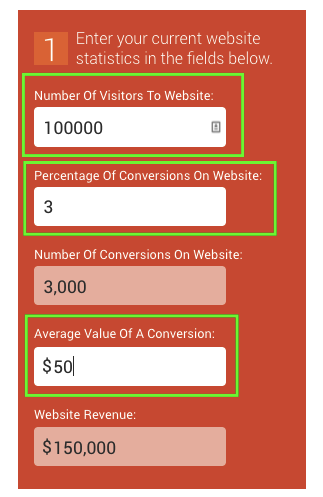
In this case, website revenue would be $150,000.
But you can take it one step further.
If you’re wondering how much your revenue would increase by increasing traffic, increasing your conversion rate or both, you can do it with ease.
Just type in the increase in percentage of traffic and/or increase in conversion rate.
Let’s say, I’m able to increase traffic by 15 percent and increase conversions by 0.5 percent.
Here’s what I get:
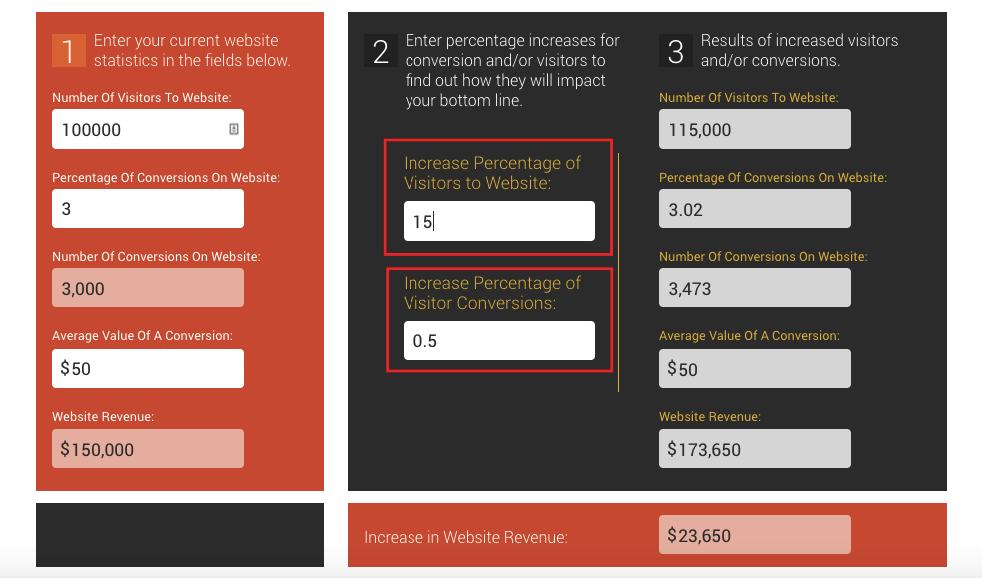
This tells me that these improvements would take my website revenue from $150,000 to $173,650 – an increase of $23,650.
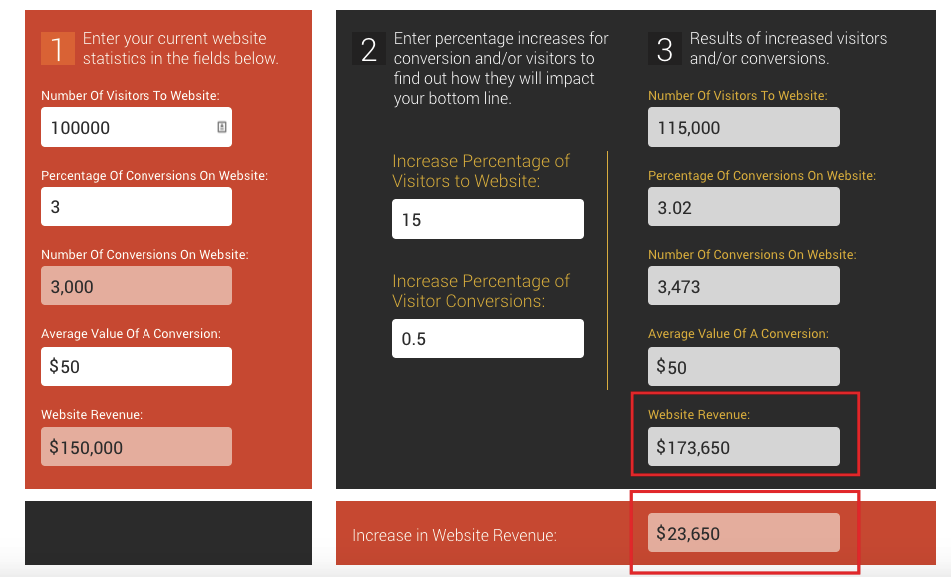
By following this simple formula, you can see exactly how your conversion rate is affecting revenue.
As for calculating churn, it can get pretty complicated and depends on a myriad of factors like how you count customers, time frame, customer segments and so on.
ProfitWell even goes so far as to say that there are 43 different ways to calculate SaaS churn.
But when broken down in its simplest form, the formula looks like this:
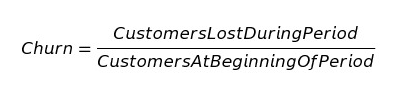
It’s important to note that churn is inevitable and is bound to occur in nearly every business.
What’s important is that you have an acceptable churn rate.
So…what’s considered “acceptable?”
Hate to say it, but it just depends.
I like the answer that David Mytton of Server Density wrote on Quora:
You can’t just pick a number and say “this is what churn should be” because it depends entirely on your customer segment.
This is a guy who knows that segmentation is crucial. Any churn rate that excludes customer segmentation from the equation is most likely misguided.
Mytton does, however, admit that it’s helpful to have benchmarks. He provides these:
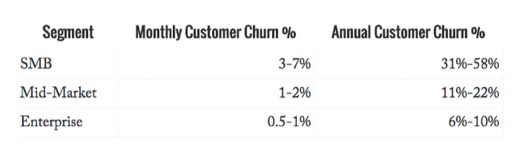
Lincoln Murphy of Sixteen Ventures suggests than an acceptable churn rate is in the 5-7% range annually or 0.42 – 0.58 percent monthly. According to Murphy, “Companies with acceptable churn only lose about 1 out of every 200 customers (or dollars) per month.”
In my experience, this sets the standard way too high.
Churn happens, regardless of how amazing your customer service, how flawless your product, or how perfect your price point is.
But there are holes that should be plugged. If left unchecked, an exorbitant churn rate will erode your revenue.
If you’re staring at an alarming churn rate — whatever that might be for your vertical and segment — start taking action immediately.
When it comes to SaaS companies, they’ll want to keep a close eye on their number of active users at any given time.
This is perhaps the best indicator of engagement and shows how many users are actually using their product on a consistent basis.
Of course, the term “active” is inherently nebulous and can be defined in a variety of ways.
Pipz Automation even calls active users a vanity metric saying that it’s too black and white to identify a user as active or inactive with nothing in between.
Although it’s an interesting argument, and determining “activeness” can depend on a variety of factors as well as the industry in question, I feel there are some concrete ways to identify active users.
So let’s get right down to it.
Perhaps the most obvious and universal is logins.
Facebook has a super simple way of defining active users, which primarily hinges upon logging in. You don’t need to Like, Comment, or use any feature to be counted as active. Just login.
We define a daily active user as a registered Facebook user who logged in and visited Facebook through our website or a mobile device, or used our Messenger application (and is also a registered Facebook user), on a given day.
If a user doesn’t do this within a 30 day period, they’re marked as inactive.
This is a means of identifying users that pretty much any SaaS company can do with ease.
Pipz Automation makes another interesting point by saying, “For all you know, ‘inactive users’ could be on vacation, or their business could be passing through a slow sales season, so they don’t have the need to login on your product for a while.”
While this is definitely food for thought, I still think that examining logins is one of the most straightforward ways to gauge active users.
Another factor to take into account is how long a user is logged in.
Having someone logged in for 10 minutes would be favorable to someone only being logged in for 2 minutes.
Although anyone who logs in would be considered as an active user, you would assign more value to someone who stays logged in for longer.
The longer your average session duration is, the better.
This is the second metric that Facebook (and many companies) use after logins.
Of course the specific type of features used can vary widely, seeing that a user is accessing key features is obviously a sign that they’re active.
For instance, Ahrefs might take a look at which specific features users were accessing most frequently from their dashboard.

You’ll probably also want to classify some features as being more important than others.
For example, you might assign more value to someone taking the time to fill out their profile rather than checking for notifications.
This would show that they’re engrossed in your software, which is a good sign.
A customer engagement index (CEI) is a way to gain even more comprehensive insights into user activity.
It involves assigning different values to a user’s actions, which ultimately gives you a snapshot of overall user engagement.
This ends up being quite helpful for determining just how active your users are on the whole.
Finally there’s the matter of customer loyalty.
This affects everything from revenue and brand equity to the long-term sustainability of your business and how competitive you are in your industry.
You’ve probably heard something like, “It can cost five times more to acquire new customers than it does to keep current ones.”
This is a good quote that shows why companies are so concerned with customer loyalty.
But here are some other interesting statistics that demonstrate the full impact of having loyal customers.
When it comes to using behavioral metrics to determine customer loyalty, looking at repurchases is usually your best bet.
If a customer is compelled to purchase multiple products from your company, it indicates at least a base level of loyalty.
They like your brand enough and have had at a pleasant enough experience to buy from you again.
The more purchases a single customer makes correlates into stronger loyalty.
When it comes to a repeat purchase rate formula, it’s really quite simple.

So if out of 100 customers,15 have shopped with you previously, you would have a repeat rate of 15 percent.
Calculating your retention rate is one of the most effective ways to gauge the collective loyalty of your customers and determine if any adjustments need to be made.
The key business drivers I mentioned – revenue, active users and customer loyalty – contribute most heavily to your company’s bottom line.
There are of course a multitude of factors to take into account, but I feel that these three are most pertinent in the grand scheme of things.
Diagnosing the health of these key business drivers revolves around identifying which behavioral metrics impact them the most.
To recap it’s these:
By analyzing these elements, you should be able to determine both your strengths and weaknesses so you can ultimately take measures to optimize your site and ultimately improve your bottom line.
What do you think is the number one most important business driver?
About the Author: Daniel Threlfall is an Internet entrepreneur and content marketing strategist. As a writer and marketing strategist, Daniel has helped brands including Merck, Fiji Water, Little Tikes, and MGA Entertainment. Daniel is co-founding Your Success Rocket, a resource for Internet entrepreneurs. He and his wife Keren have four children, and occasionally enjoy adventures in remote corners of the globe (kids included). You can follow Daniel on Twitter or see pictures of his adventures on Instagram.


You may already know that Oracle leads the way in designing sustainable world-class events for customers, partners, developers, and employees. But we wanted to give you an in-depth glimpse of how that commitment plays out at Oracle OpenWorld. Here’s a look back at Oracle OpenWorld 2016 to see the results of our hard work.

https://blogs.oracle.com/11-oracle-openworld-sustainability-accomplishments

You can watch the video on Youtube here : https://youtu.be/RdX_VrmXQts

The next content was first seen on SociDeck Review : Bonus
SociDeck is a feature-packed social media management software that converts social conversations into conversions by allowing users to manage their 3 biggest social media accounts – Facebook, Twitter and Instagram at one place.
It makes social media marketing journey a cakewalk, and your customers can schedule and queue their social media posts, get complete analytics, manage their brand reputation, increase leads and sales and get maximum results by making their social interactions result-oriented.
And the biggest catch is this simple cloud based software requires – no complicated installation, no hosting and no technical hassles. SociDeck is the simplest, fastest, and easiest social media management machine that removes all worries and tireless hassles of managing multiple social profiles. And that’s not all, you can also :

The next article was first seen on SociDeck Review : Bonus

You can watch the video on Youtube here : https://youtu.be/h8WJx3bE_uQ


